
Which types of pipes are tend to have root incursion? And when its usually happening?

Due to the specific hot climate, trees are constantly looking for water, which makes root incursion a frequent problem for homeowners of San Diego and surrounding areas. Here we will try to specify, which types of pipes are more likely to have this problem, and what can be done to prevent, or resolve root incursion earlier, before they grow in too much.
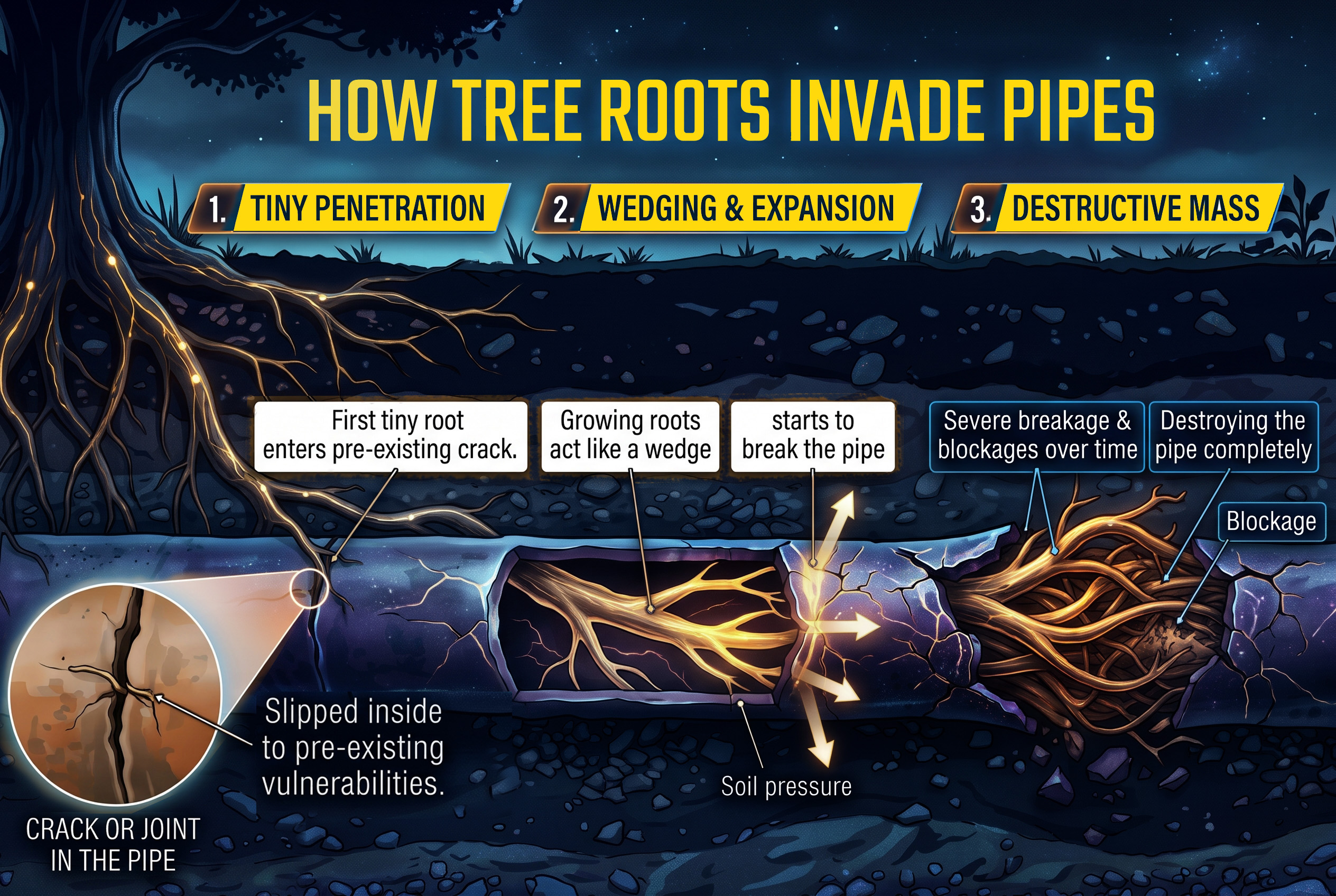
While it can look not so serious in the beginning, tree root intrusion is easily one of the most destructive problems a homeowner can face in their main sewer line. Modern research, published by the USDA Forest Service reveals, that tree root intrusion causes over 50% of all main sewer line blockages nationwide. However, tree roots don’t penetrate solid pipes on their own—they exploit pre-existing structural vulnerabilities.
“Roots never break the pipe first. First, they find a broken pipe and grow in. Roots start small, but over the years they break it more and more until it becomes a monster in your drain.”
The susceptibility of a sewer line to root invasion depends heavily on its material, age, and joint design. Older vitrified clay sewer lines are laid in short sections. As mortar joints degrade or soil shifts, tiny hair roots enter the gaps. Because clay is brittle, growing roots act like a wedge—expanding inside joints and eventually cracking or shattering clay pipes completely. Industry studies show pipes installed before 1980 account for nearly 80% of root intrusion service calls.
Common in older homes, cast iron corrodes over time from sewer gases and exterior moisture. As the metal scales and forms hairline cracks, tiny roots slip inside and expand over time.
“Cast iron looks tough on the outside, but once the interior walls scale and pit from decades of moisture, it forms tiny fissures. Roots love those hidden gaps because they trap moisture and organic nutrients, letting them quietly settle in before anyone notices a backup.”
Meanwhile, Orangeburg pipes made of bituminized fiber flatten over time, offering zero resistance to invading tree roots. In contrast, modern ABS and PVC plastic piping is smooth and largely impervious to roots unless solvent-welded joints are improperly sealed or cracked by heavy ground movement.
When Does Root Incursion Usually Happen?
Root intrusion is a gradual process that accelerates under specific environmental conditions:
- Structural Pipe Failure: Before roots enter, the pipe must fail first. Over decades, pipe corrosion or joint settling creates tiny openings that release water vapor into the surrounding soil.
- Drought & Dry Seasons: During dry summer months, trees actively send out feeder roots in search of subterranean moisture sources.
- Spring Growth Surges: As vegetation awaken in early spring, root expansion speeds up rapidly, expanding small hair roots into dense masses.
How to Stop Root Intrusion Before Serious Sewer System Damage?
Many homeowners rely on hydro-jetting to clear blocked drains, but pipe material dictates the right approach. High-pressure water jetting (4,000 PSI) is 100% safe for modern ABS lines, but applying that same pressure to compromised cast iron can collapse fragile walls faster than the roots themselves. Creating a new seamless liner inside your old sewer system with epoxy lining effectively seals off all entry points, preventing roots from ever returning.
In addition to trenchless CIPP lining, taking proactive steps around your property helps protect subterranean plumbing over the long term. Planting large trees at least 10 to 15 feet away from known sewer pipe paths minimizes direct root contact. Installing physical root barriers along main line trenches also redirects root expansion downward, reducing the likelihood of early structural pipe damage.
Also, for properties with trees nearby we advise to run diagnostic sewer camera inspection at least once a year, since they are prone to root intrusion, which can cause cracks or blockages. As trees seek out moisture, oxygen, and nutrients, their subterranean root systems naturally extend toward underground plumbing. Camera inspection quickly identifies these problems, pinpoints its exact location and depth, to enable precise repair planning.