
Twenty Years Under San Diego: A Plumber on the Truck You Didn’t Hire

An interview, three stories, and one quiet rule that changed how I run a plumbing company.
By Vlad Khorenko, CoOwner, Almco Plumbing
Part I — The Interview
I asked Vlad if we could sit down for an hour. He suggested his shop in Kearny Mesa, late afternoon, after the trucks come back. There’s a small office in the corner with a whiteboard covered in job numbers and a coffee machine that looks like it has seen things. He poured two cups, black, and sat down across from me with the patience of a man who has spent most of his adult life waiting for water to drain.
Q: People who meet you now see the owner. But you didn’t start here. Where did you start?
In a crawlspace. Literally. My first paid plumbing job in California was crawling under a duplex in Clairemont with a flashlight in my mouth, trying to figure out which cast iron pipe was leaking and which one only looked like it was. I was twenty-two. I had a wrench, a borrowed van, and a gut feeling that I would either learn fast or get out of the trade in six months.
Q: And the path from there to running a company — what does that actually look like?
Slow. People imagine a clean arc. It isn’t. You become a better plumber. You start finishing jobs that other guys couldn’t. Customers call you back. You hire a helper. You buy a camera. You buy a second truck. You make mistakes — payroll mistakes, hiring mistakes, pricing mistakes. You learn what a real estimate looks like versus a hopeful one. Eventually you realize the company has a shape, and the shape is a reflection of every decision you made when no one was watching.
Q: Almco has a reputation for running the specialized trenchless work — CIPP lining, pipe bursting, spray coatings — entirely with our own equipment and our own crews. That’s unusual at this scale. Why?
Because I started on the other side of that equation.
Q: Meaning?
Meaning for a few years, before I had my own customers, I was the white truck. I was the guy parked at home on a Tuesday morning waiting for the phone to ring, hoping some company with a wrapped fleet and a sales office had bid a lining job too low and now needed a real lining crew to bail them out. That’s a specific kind of education. You see exactly where the numbers come from and where they go. You see what the homeowner was promised and what the budget actually allows. Once you’ve worked that side of it, you stop being able to pretend you didn’t.
Q: Let’s be precise here, because “no subcontractors” is the kind of phrase that gets thrown around in plumbing marketing and it doesn’t always mean what people think.
Right. I’ll be honest about this. Plumbing companies use subs all the time, and a lot of it is fine. If a job needs asphalt patched at the end, we’ll sometimes bring in a paving guy. If a permit requires a specific kind of soils report, we hire a soils engineer. That’s normal. Nobody owns every kind of expertise.
What’s not normal — what people don’t realize is happening — is that most of the companies bidding residential trenchless sewer work in San Diego don’t actually own the trenchless equipment. The CIPP inversion rig, the pipe bursting setup, the spray coating system, the steam cure unit — each of those is a six-figure piece of equipment, plus the consumables, plus the training, plus the trucks built around it. Most local plumbers don’t have any of it. So when they sell you a liner, they’re not lying about the method. They’re just planning to call somebody else to actually install it.
Q: And from a homeowner’s perspective, why does that matter?
Because the company on your contract is making a price-and-method decision on a problem they personally can’t see, with equipment they don’t own, on a budget they pulled out of thin air. And when the real crew shows up with the real equipment and gives them the real number, something has to give. Usually it’s the work.
Q: We’re going to come back to that. But first — when you talk to property owners now, what do you wish they understood before they signed anything?
That the company on the contract is not always the company on the jobsite. That a bid which is dramatically lower than the others has a structural reason, and the reason is usually not efficiency — it’s that the person selling has never priced the actual work. And that when something goes wrong sixteen feet under your front yard, the only thing that matters is whether one person — one — is willing to put their name on the fix.
Q: Let’s tell some stories.
Let’s tell some stories.
Part II — The House in Kensington
Couple of years back I got a call on a Wednesday morning from a woman in Kensington. House from 1948. They had lived there twenty-three years. Two kids grown and out, one grandkid on the way, and a sewer line that had decided that twenty-three years was enough.
The backups had started maybe a year before they called anyone. First it was just slow drains. Then it was a gurgle in the kitchen when the washing machine ran. Then it was a Sunday morning when the downstairs shower wouldn’t drain and her husband went outside and found that the cleanout in the side yard had decided to share its opinion with the lawn.
She did everything right. She got three bids.
The first two were from established San Diego plumbing companies. Their numbers were within a few hundred dollars of each other. Both proposed running a camera first to confirm what the line looked like, both suspected the line was a candidate for a CIPP inversion liner with a pipe bursting section near the city connection, and both wanted to do a real diagnostic before quoting the final number. One of them gave her a range and explained what would push it higher or lower.
The third bid came from a contractor with a sales office in Mira Mesa. Bright orange truck wrap. Glossy folder with reviews printed on cardstock. A tablet pitch with before-and-after photos that, I noticed later, had no project addresses or dates on them. The number was about thirty percent lower than the other two. He told her his crew could finish the whole job in three days with no trenching across the lawn. She signed with him on a Friday.
A different truck showed up Tuesday morning.
It was a plain white box truck with no logo. The two guys who got out of it had unbranded shirts and a tablet that did not appear to know who she was. She asked one of them which company they were with. He named a small outfit out of Lakeside she’d never heard of. She asked when the foreman she’d talked to in the sales office would arrive. The guy on his phone looked over and said, friendly enough, “He’s not on this one, ma’am. We’ve got it from here.”
They ran a camera. Which was a good sign in one direction and a bad sign in another — good because at least someone was finally looking at the actual pipe, bad because it meant the company she had signed with had never looked at the actual pipe before quoting the work.
What the camera found was about what the first two companies had predicted. A long section of cast iron that could be lined, a roughly twenty-foot run near the property line where the pipe was structurally collapsed and not a candidate for lining at all, a belly under the driveway, and root intrusion at three joints.
The sub called the orange-truck contractor and explained. The pipe needed prep work — heavy descaling — before any liner would bond. The collapsed section needed pipe bursting, not lining, which meant a second access pit. The connection at the city tap needed a connector liner because the geometry was wrong for a continuous inversion. None of that was in the original scope. The price the sub was being paid wasn’t even close to enough to cover it.
The contractor told him to make it work.
The sub said no. To his credit. He told the contractor he wasn’t going to install a liner over a section he knew was going to fail inside a year, because his name — even if it wasn’t on her paperwork — was on the liner.
The contractor told the sub to pack up.
What the homeowner saw, from her kitchen window, was a crew that arrived in the morning, ran a camera, made some phone calls, sat in the truck for an hour, and then left at eleven-thirty without saying anything to her. By the afternoon, the orange-truck contractor was not returning her calls. By the next morning, the cleanout in the side yard was still open, her front lawn had a six-foot exploratory trench in it from where someone had started and then stopped, and the sales rep who had been so attentive the week before had gone silent.
She found us on a Thursday. We came out Friday morning. The trench had been sitting open for three days; the city had already left a note about it.
Q: What did you tell her when you walked the property?
The truth, which is the part of this job I like the least. I told her the previous quote had been wrong from the start — not because the contractor was dishonest, but because he hadn’t done the work he needed to do to price it. He had quoted a method without diagnosing the problem. The real job was lining for most of the run, bursting for the collapsed section, a connector liner at the city tap, and a proper cleanout install. None of which his crew was equipped to do.
Q: And what did the wrong quote cost her?
A delayed job. Three days of an open trench. A small repair to the irrigation line the previous crew had nicked. The deposit she had paid the orange-truck contractor, which she eventually got about forty percent of back after a small claims filing. And the price of doing the work correctly, which was, of course, in the same range as the two original honest bids she had rejected a month earlier.
The “savings” turned into an extra eight thousand dollars and a month of stress.
I tell this story not because it’s unusual but because it isn’t. I see a version of it eight or ten times a year. The specifics change. The structure doesn’t.
Part III — How the Math Actually Works
Let me back up and explain what was actually happening behind the scenes in that story, because if you’ve never been on the inside of the trades, the mechanics are not obvious.
A trenchless sewer rehab on a residential property is a specialized job. The equipment alone — an inversion drum, a steam cure unit, a pipe bursting rig with the hydraulic puller, a spray coating system, a high-pressure jetter rated for descaling, a self-leveling pipe camera — costs somewhere north of three hundred thousand dollars if you buy it new. The training costs more. The trucks built to carry it cost more. The consumables — felt liners, epoxy resin, structural fiber — are not cheap and don’t have a long shelf life.
For a local plumbing company doing a few residential laterals a month, none of that math works. They cannot justify owning the equipment. So they have two choices. They can specialize away from trenchless and just do dig-and-replace, which is honest and which some good companies do. Or they can sell the trenchless work and then call someone like the small Lakeside outfit in the Kensington story to actually do it.
The second option is where the structural problems start.
When a contractor who doesn’t own the equipment bids a trenchless job, they are essentially guessing. They look at the address, maybe pull up a satellite photo, ask the homeowner a few questions, and produce a number. They have not run a camera. They do not know what the pipe looks like at thirty feet. They do not know whether the line is a candidate for inversion or pull-in-place. They do not know whether there’s a belly, an offset, a collapsed section, or a back-pitched run from a previous repair. They are pricing a method, sight unseen, against a problem they haven’t diagnosed.
Then they call a sub. The sub, who does own the equipment, gives them a number based on the sub’s actual costs plus the sub’s actual margin. The contractor compares that number to what they sold the job for. If the math works, the job proceeds. If it doesn’t, the contractor has three options.
The first option is to eat the loss. In my twenty-plus years of watching this industry, I have never personally seen this happen on a residential job.
The second option is to lean on the sub. Just make it work. Skip the descaling. Skip the pre-camera. Run a thinner liner. Don’t worry about the connector at the city tap, just butt-join it and hope. Sometimes the sub agrees. Sometimes — like in Kensington — they don’t. Either outcome is bad for the homeowner, just in different ways.
The third option is to go silent. The contractor stops returning the homeowner’s calls, the sub disappears because their contract is with the contractor and not with you, and the property owner is left with an open trench, a partial repair, and a deposit they may or may not ever see again.
Q: And the crew that actually showed up — the sub — they’re not the bad guys here?
In most cases, no. The crew that showed up at her house probably could have done excellent work on a real budget with a real scope. They didn’t get one. They got a number and a deadline from a contractor who had sold something he didn’t understand the cost of, and they were asked to make it work. That’s not a recipe for craftsmanship. That’s a recipe for shortcuts, or for walking off the job, depending on how much self-respect the crew has.
I know this because, as I said, I used to be that crew. I used to drive to a job with a number in my head that I knew wasn’t enough, and I used to make small compromises you make when you’re trying to finish work at a price that doesn’t cover doing it right. I’m not proud of that period. But it taught me how the industry is wired underneath, and it’s why I built Almco the way I built it.
Q: One thing I noticed in the Kensington story — the white truck. You said earlier that’s a marker. Is that a real signal?
It’s not infallible, but it tells you something. On a commercial project, you’re not going to see an unmarked truck pull onto the property — the GC has paperwork requirements, the building has insurance requirements, every sub that crosses the gate is logged and bonded. Commercial filters that stuff out at the front desk.
Residential is wide open. Nobody is checking. The “closer” you signed with has every reason to stay invisible during the actual work, because if you meet the crew and find out who they actually are, you might call them directly next time. So the trucks are unmarked, the shirts are blank, and the foreman, if you ask, gets vague. That vagueness is the signal. You don’t need to be a detective. You just need to notice what isn’t there.
Part IV — The Property Manager in Pacific Beach
Second story. Different scale, same disease.
Two years ago, a property manager called us about a four-unit residential building in Pacific Beach. Old construction. Original sewer lateral was failing — roots had gotten into a couple of joints and were forming the kind of mass that no amount of jetting was going to permanently fix. He needed it replaced.
He had already hired someone. A different company. They had quoted him for a traditional dig-and-replace because, they said, the line wasn’t a candidate for trenchless work. They had started the job, opened a trench across the front of the property — which, in Pacific Beach, means tearing up landscaping, sidewalk, and a strip of street — and then, halfway through, hit a complication. There was a second lateral they hadn’t accounted for. They needed more time, more money, and access to a neighboring property.
When the property manager pushed back on the additional cost, the company essentially shrugged. They said the excavation sub they had brought in had finished his contracted work and was now on another job. They could continue, but at a new rate and on a new schedule.
He called us for a second opinion.
We came out, looked at the open trench, ran a camera through what was accessible, and told him something he wasn’t expecting: the line had been a candidate for trenchless work. Specifically, for pipe bursting — a method where we pull a new pipe through the path of the old one, fracturing the old pipe outward as we go, with two small access pits instead of a forty-foot trench. We could have done the entire job in two days without touching the sidewalk or the landscaping.
Q: Why hadn’t the first company offered the trenchless option?
Same reason as Kensington. They didn’t have the equipment. They had a truck, a backhoe operator on the books, and a relationship with an excavation sub. Dig-and-replace was the only method they could actually deliver, so dig-and-replace was the only method they quoted. Pipe bursting wasn’t presented as an option because, from their perspective, it wasn’t one — not because the pipe couldn’t take it, but because they couldn’t take it.
This is the second hidden cost of the broker model, and it’s the one homeowners almost never catch. It’s not just that the work sometimes gets done badly. It’s that the recommendation itself is constrained by what the company in the truck is capable of doing. They’re not really diagnosing your pipe. They’re matching your pipe to the small list of things they can handle.
When my crew quotes a CIPP inversion liner, or a pull-in-place liner, or a spray brush coating, or a pipe bursting run, or a structural fiber repair on a single joint, we’re picking the method that fits the actual pipe — because all of those options live inside our shop and inside our trucks. Nothing on that list is something we’d have to call somebody else about. The recommendation is honest because the menu is real.
Part V — The Homeowner Who Asked the Right Question
Third story. This one ends well, because the customer asked the question that everyone should ask.
A man in North Park called us about a recurring backup at a 1952 single-family home he had bought eighteen months earlier. The previous owner had snaked it. The home inspector had flagged it as something to watch. Two other plumbing companies had already cleared it once each in the year and a half since the closing. He finally accepted he needed real diagnostic work and probably some kind of repair.
He got three bids. Ours was the middle one. Before he signed, he asked me one question on the phone:
“If I hire you, who is going to be in my driveway on the day of the work?”
I told him: my crew. My foreman, by name. Our truck. Our camera. Our jetter. If we end up needing to do a CIPP inversion liner on a section, that’s our inversion drum, our resin, our cure unit. If we determine we need a connector liner at the city tap, we’ll do that ourselves. If a section needs to be burst, that’s our bursting head and our hydraulic puller. The only person who’s going to walk onto your property wearing a different logo is a city inspector if the permit calls for one.
He hired us. The job took a day and a half — pull-in-place CIPP liner on the main run, connector liner at the city connection, and a new cleanout we installed near the foundation so future maintenance wouldn’t require digging. Line is still working. He sends us a referral every couple of months.
The reason I tell this story is that the question he asked — who is going to be in my driveway on the day of the work — is the single most useful question a property owner can ask before signing a contract for any kind of trade work. Not “what’s your price.” Not “how long have you been in business.” Not “do you have insurance.” Those questions matter, but they’re easy to answer and easy to make sound good.
The question of who, specifically, is going to be on your property is the question that exposes the gap between the company that won the bid and the people who will actually be doing the work.
If the answer is “our crew” and they can name the foreman, you’re probably in good shape. If the answer is vague — “a crew,” “our people,” “a partner of ours,” “one of our trusted teams” — keep asking. If the answer is some version of “we work with a network of specialists in your area,” you have your answer, and it’s not the one you wanted.
Part VI — Why I Built Almco the Way I Built It
I want to be careful here, because I’m aware that this whole piece can read as a long advertisement for my own company. That’s not the intent, and I think the stories above are useful regardless of who you eventually hire. The principles are the same whether you call us, call one of the other good companies in San Diego, or hire a single licensed plumber working out of his own truck.
But since I’ve been telling you about other people’s businesses, let me tell you briefly about mine.
When I started Almco, the first decision I made — before I had a real office, before I had a logo, before I had a website worth showing anyone — was about which work we would own and which work we wouldn’t. The rule I settled on, and the rule we still run by, is this: any specialized technology we sell, we operate. Any complex method we quote, we own the equipment for. Any sewer rehabilitation that goes on your property is performed by people on our payroll, in our trucks, with our gear.
That doesn’t mean we never use a sub for anything. If a job ends with asphalt that needs patching, sometimes we bring in a paving guy. If a permit requires a specialty inspection, we hire the specialty inspector. That’s how the trades work; nobody owns every skill in the toolbox.
What we will not do — what the rule is actually about — is sell you a technology we don’t own and don’t operate. We will not quote a CIPP liner that we plan to broker out to whoever picks up the phone on Tuesday morning. We will not sell pipe bursting on a job and then start calling around to find someone with a bursting rig. We will not put “trenchless rehabilitation” on a contract and then make a margin by reselling someone else’s labor.
That decision has cost us money. There are jobs we’ve turned down because we didn’t have the right tool yet. There are months when we’ve grown more slowly than we could have if we’d been willing to broker work. There are specialties that took us years to bring in-house — the CIPP inversion equipment, the pipe bursting setup, the spray-in-place coating gear, the brush coating rig, the structural fiber repair kit — because each of them required real capital and real training before we’d put them on a quote.
What that decision has bought us, in return, is the ability to look every customer in the eye and tell them, honestly, who is going to be on their property and who is responsible if something goes wrong. The answer is always the same. It’s our crew. And the responsibility is mine, with my license on it and my insurance behind it.

The license part is not a small detail. In residential plumbing, the license is what gives the work legal standing — what makes a warranty enforceable, what makes a permit valid, what gives a homeowner recourse if something goes sideways. When a contractor brokers out the specialized portion of a job to a sub, the sub is doing the work but the license on your paperwork belongs to the contractor. If the contractor goes silent — like the orange-truck guy in Kensington — your license-holder is unreachable, and the people who actually did the work have no contractual relationship with you. That gap is where homeowners get stranded.
When the trucks in your driveway have our name on them, the people in those trucks are on our payroll, the equipment they’re using was bought by us, and the warranty paperwork has my company’s name and my phone number on it — there’s no gap. There’s no “let me check with my partner.” There’s no “I’ll have to call you back about that.” There is one team. There is one standard. There is one warranty.
For a homeowner with a single sewer lateral, that matters in a very practical way. If your line fails on a Tuesday, the difference between a real in-house operation and a well-dressed broker is the difference between a job that gets done and a job that gets argued about. You don’t have time, on a Tuesday, to figure out which contract goes with which crew. You need the people who showed up to be the people responsible.
Part VII — A Few Things to Take With You
I’ll close with the practical version of everything I’ve been saying, because I know not everyone reading this is going to remember a forty-minute interview. Here are the things I’d want a property owner to take away.
The lowest bid is rarely the lowest cost. It’s the lowest first number. The actual cost includes the things that go wrong, the days you lose, the work that has to be redone, and the warranty that may or may not actually be honored. When you’re comparing bids that differ by more than fifteen or twenty percent, the cheapest one is almost always cheap for a reason that surfaces later.
The company that signs the contract is not always the company that does the work. Ask. Get the answer in writing if you can. For any kind of trenchless sewer work — CIPP lining (inversion or pull-in-place), pipe bursting, spray coatings, brush coating, structural fiber repair, connector lining — ask specifically whether the company you’re talking to owns the equipment and employs the technicians. If they own a backhoe and a snake and nothing else, they don’t actually do trenchless work; they sell it.
A camera inspection is not a sales tool. It’s a diagnostic tool. Any reputable company should put a camera in your line before quoting a major repair, show you the footage in real time, and explain what they’re seeing. If a company quotes a six-thousand-dollar method without ever looking inside your pipe, you are being sold a number, not a diagnosis. The number is a guess. Sometimes a lucky guess. Often not.
Ask who is responsible. Specifically, ask: if something fails six months from now, whose name is on the warranty, what is the process for getting it honored, and what license is backing it. If the answer involves multiple companies, multiple contracts, or any version of “we’d have to figure that out,” you don’t have a warranty. You have a hope.
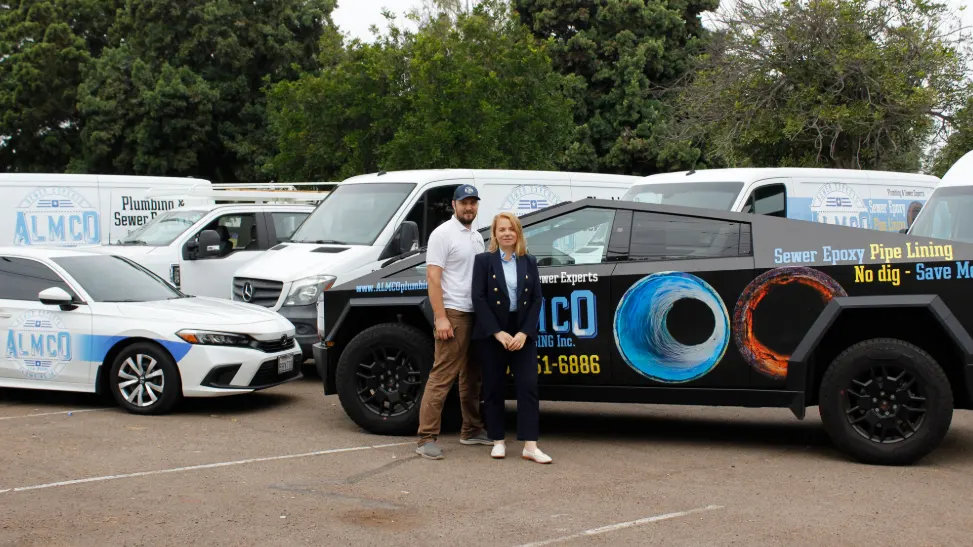
Watch the trucks. This sounds petty, and it isn’t. The truck that pulls into your driveway on the morning of the work tells you a lot about who you actually hired. A wrapped, branded truck with the company’s license number on the side, driven by people in branded shirts, is a company that wants you to be able to find them again. An unmarked white truck with no logos on it, driven by people who can’t tell you the foreman’s name, is a sub who has no relationship with you and no obligation to you once the day is over. You don’t have to confront them. You just have to call your contact at the company that sold you the job and ask why the crew isn’t theirs.
And finally — and this is the one I care about most, because it’s the lesson I learned the hard way on my own jobs, twenty years ago — the people doing the work matter. Not the salesperson. Not the office. The people who are actually going to be in your front yard, in your crawlspace, lining your pipe. Find out who they are. Ask whether they’ll be there. And if the company you’re hiring can’t tell you, or won’t, that’s the most important piece of information you’ll get during the entire process.
That’s all I’ve got. The coffee’s gone cold. I have to go look at a camera inspection in La Jolla in the morning.
Vlad Khorenko is the founder of Almco Plumbing, a San Diego-based sewer rehabilitation company. Almco owns and operates all of its trenchless equipment in-house, including CIPP pull-in-place lining, CIPP inversion lining, SIPP spray coating, brush coating, structural fiber repairs, pipe bursting, and connector liners. If you’d like a free camera inspection and estimate for your property, you can reach the office at +1 (858) 544-6331.